

- SREA submitted comments regarding the TVA 2026 Integrated Resource Plan (IRP)
- The plan is a long-term study that provides strategic direction on how TVA could meet customer demand for electricity over the next 20+ years, continuing to provide low-cost, reliable, and resilient electricity to the residents and businesses across the Valley region.
- IRPs can give a sense of where the utility is moving, but it doesn’t restrict them to one set path.
The Southern Renewable Energy Association today submitted comments on TVA's 2026 Integrated Resource Plan (IRP), highlighting several areas of concern, including the plan's lack of transmission planning, the forced modeling of certain resources, and the capacity values assigned to different generation technologies.
An Integrated Resource Plan is a long-term study that provides strategic direction for how a utility could meet its customers' electricity needs over the next 20 or more years. For TVA, the IRP is intended to help chart a path toward providing low-cost, reliable, and resilient electricity to residents and businesses across the Tennessee Valley.
IRPs can give stakeholders a sense of where a utility is headed, but they do not bind the utility to a single path forward.
TVA undertakes the IRP process every five years, with its last plan finalized in 2019. As part of the stakeholder engagement process for the 2026 IRP, SREA submitted comments on July 22.
We had some thoughts.
The TL;DR
SREA encourages the TVA Board of Directors to evaluate the 2026 IRP with a critical eye. If resource planning is conducted in a way that predetermines the outcome, the process becomes more of an academic exercise than a meaningful tool for decision-making.
We also encourage TVA to use competitive solicitations that evaluate all generation solutions on an even playing field. Doing so would help test some of the assumptions embedded in the IRP and ensure that TVA is considering the most cost-effective and reliable resources available to meet future demand.
Among the specific concerns SREA raised in our comments are:
- A complete lack of transmission planning. Without strong transmission access, new generators cannot adequately plug into the grid system.
- Forced modeling of nuclear generation, despite nuclear being among the most expensive options evaluated and TVA having limited remaining debt capacity to finance large-scale investments.
- Capacity values assigned to different generation technologies that appear to undervalue renewables while assigning relatively high values to natural gas generation.
Why Are IRPs Important?
Integrated Resource Planning is a public process through which utilities develop a strategy for meeting their customers' future energy needs. The process is important because it allows regulators and other stakeholders to "look under the hood and double check the math from the utilities," as Southern Renewable Energy Association Executive Director Simon Mahan said in a recent article.
A clear, reasonable, and well-vetted IRP is also essential to attracting new economic development and generation resources to the region. If companies looking to expand or locate in the Valley view TVA's resource plan as flawed, incomplete, or otherwise disconnected from reality, the region could be deprioritized for future growth.
Unfortunately, there are already signs that this may be happening.
In 2023, approximately 149 projects were in TVA's generator interconnection queue, representing nearly 30 GW of potential new generation. Today, there are just 97 projects, representing less than 23.5 GW, with most of the remaining projects proposed by TVA.
That makes it critically important for TVA's IRP to present a realistic picture of the region's future energy needs and the resources required to meet them. Between now and 2030, TVA's load forecast grows by approximately 1 to 3 GW, and by as much as 6 GW by 2035.
Without enough generation to meet that additional demand while maintaining an adequate reserve margin, economic development across the TVA region could be constrained.
What Does TVA's 2026 IRP Model?
For its 2026 IRP, TVA evaluates three separate load forecasts:
- Scenario 1: Mid-level load forecast
- Scenario 2: High load forecast
- Scenario 3: Low load forecast
TVA then combines these three scenarios with three different strategies—Strategies A, B, and C—to create nine potential portfolios. Across the portfolios, TVA assumes higher levels of nuclear and natural gas additions and fewer renewable resources than were included in the 2025 IRP.
As SREA noted in its comments:
"Evaluating capacity additions between now and 2030 compared to 2035 highlights the significant quantity of assumed or non-modeled generation resources included in the IRP."
Nearly 6 GW of new generation capacity is assumed by 2030, with most of that coming from natural gas combined-cycle (CC), combustion turbine (CT), and battery resources.
This raises an important question: How much of TVA's near-term resource plan is actually being determined by the IRP model, and how much is being decided outside the model?
A Lack of Transmission Planning
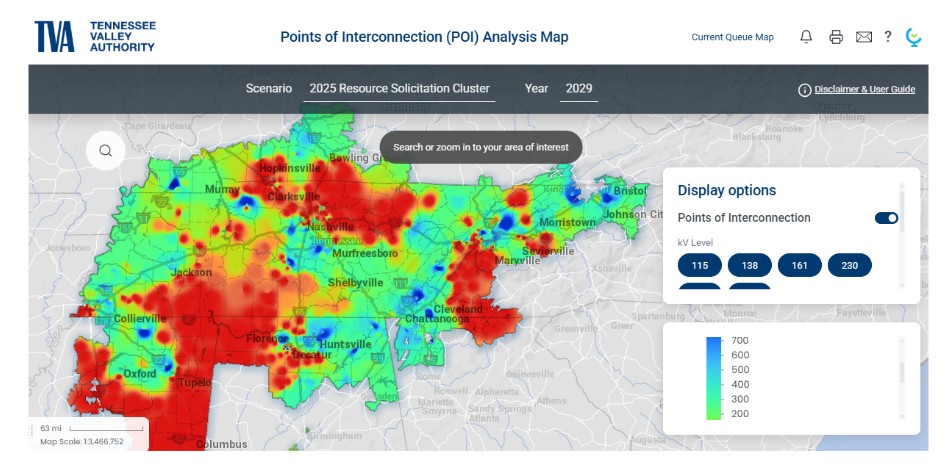
One of SREA's most significant concerns is the IRP's complete lack of transmission planning.
Changes to the generation mix - whether additions or retirements - have direct implications for the transmission system. Transmission is also critical during extreme weather and unexpected generator outages.
During Winter Storm Elliott in 2022, power flows from MISO into TVA helped limit the severity of power outages. The event demonstrated that transmission can serve as a vital lifeline when a region is facing extreme system stress.
Yet,the 2026 IRP does not meaningfully address these issues.
TVA participates in the Southeastern Regional Transmission Planning Process, or SERTP, which has yet to build a single new transmission line despite being in existence for nearly two decades. As part of its participation in SERTP, TVA provides assumptions about generation additions and retirements. However, those assumptions do not include any new nuclear additions in the next decade, even though the 50 MW Hermes project is currently in the queue.
Without accurate assumptions about future generation resources, transmission planning becomes, at best, an academic exercise.
Forced Modeling of Gas and Nuclear Resources
Another concern is the way the IRP handles the timing and selection of new generation resources.
TVA assumes that new generation resources are only available beginning in 2031—five years from now. Yet, based on the three load-growth scenarios, TVA faces significant capacity needs within the next five years.
The IRP therefore does not meaningfully evaluate how TVA could meet those near-term needs. Because TVA often conducts new analysis within every five years, a new IRP will likely be conducted and completed before this 2026 IRP is implemented.
This is a major deficiency in the planning process and unnecessarily limits the resources available for consideration, particularly renewable energy resources that may qualify for federal tax credits.
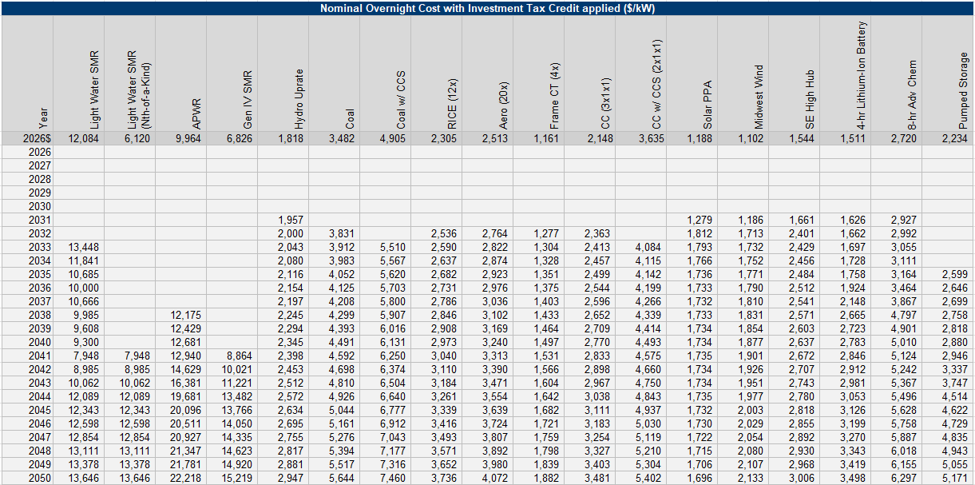
For the model's build decisions beginning in 2031, the available resources include hydro uprates, solar PPAs, wind energy, and battery storage. Generation resources that appear in the portfolios before 2031 seem to have been manually selected, or "baked in," outside of the capacity expansion model.
Preselecting generation additions is fundamentally at odds with the purpose of a modeling exercise designed to inform decision-making.
The issue is particularly concerning when it comes to nuclear generation. Nuclear resources are the most expensive resources evaluated in the IRP - more expensive than new coal, coal with carbon capture and sequestration, or natural gas with carbon capture and sequestration.
According to TVA's own analysis, adding 1,000 MW of any of the nuclear technologies evaluated would cost approximately $8 billion to $12 billion in the 2030s, even after accounting for federal subsidies currently available for new nuclear units.
TVA's debt ceiling is $30 billion, with only approximately $7.9 billion in remaining headroom. Any significant nuclear buildout would therefore require substantial federal funding, additional subsidies, or innovative partnerships off the TVA’s books.
Given these constraints, it is surprising that every portfolio includes some level of nuclear generation.
This raises questions about whether nuclear additions are being driven by the model itself or by manual assumptions and limitations built into the modeling process. The inclusion of 1,110 MW of new APWR capacity in several portfolios is also unusual and provides another signal that nuclear resources may have been effectively forced into the model.
A Strong Reliance on Natural Gas
The IRP also signals a strong reliance on combined-cycle (CC) and combustion-turbine (CT) resources.
Reciprocating internal combustion engine (RICE) and aeroderivative (aero) generation are also included in the modeling. However, under no scenario does the model select natural gas with carbon capture and sequestration, likely because of its high cost. It should be noted that while no carbon capture technology was selected by the IRP model, those technologies are lower cost than nuclear resources in the model.
By 2034, many portfolios stop adding new CC units and then shift toward CT additions in the late 2040s. There is also an interesting pattern in the near-term capacity additions. While two portfolios show the same amount of gas capacity additions by 2030, the remaining seven portfolios also converge on the same level of capacity additions in 2030.
This led SREA to conclude:
"TVA's five-year plan for capacity additions are not driven by the IRP model, but instead by some separate internal guidance."
If the model produces nearly identical near-term outcomes across dramatically different load scenarios and strategies, it is fair to question how much influence the model actually has over TVA's five-year resource decisions.
Are Capacity Values Undervaluing Renewables?
Another concern is the capacity value assigned to different generation technologies.
SREA believes that relying on fixed accreditation values for solar and wind across different scenarios can inaccurately assess the true value of these resources. At approximately 6 GW of solar capacity, solar's accreditation reaches an inflection point, achieving approximately 50% during the summer before declining rapidly.
The IRP uses Effective Load Carrying Capability (ELCC) calculations that rely on base-load projections. If load projections are significantly higher in one scenario than another, the ELCC valuation of a resource can remain higher as additional nameplate capacity is installed.
Put simply, assigning lower capacity values to solar resources can unnecessarily devalue them within the model.
Winter capacity accreditation for solar also deserves a closer look. It is true that solar, on average, produces less energy during winter peak periods than during summer peaks. However, recent data suggests that solar can perform particularly well during the extreme weather events that drive peak demand.
During Winter Storm Elliott in 2022, for example, more solar on TVA's system could have helped reduce the severity and duration of outages.
A post-storm analysis found that solar resources performed exceptionally well across Southern Company's territory during Elliott. That performance helps explain, at least in part, why Southern Company was able to weather the event without the major disruptions experienced by TVA.
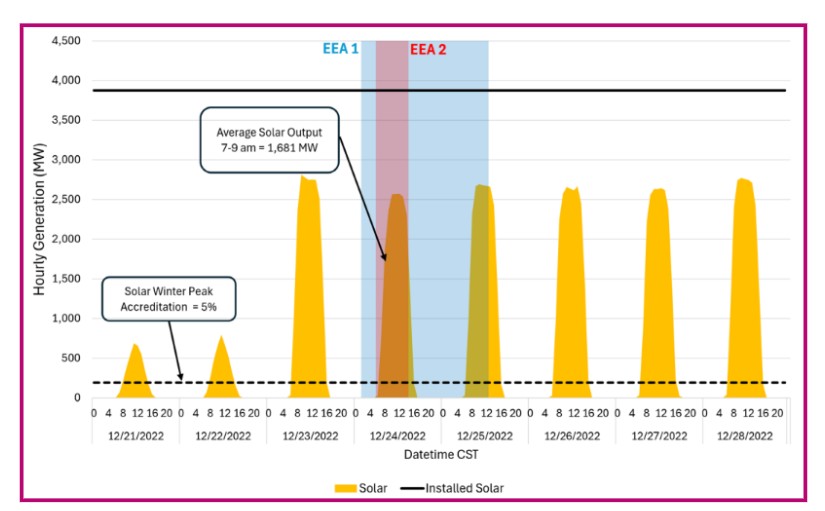
Source: Winter Storm Elliott Report, Telos
The outages TVA experienced during Elliott were driven primarily by failures at natural gas and coal-fired generation facilities—not renewable resources.
That brings us back to the capacity values used in the IRP.
By undervaluing renewable capacity while assigning relatively high capacity values to natural gas generation, the IRP may be steering TVA toward significantly more natural gas additions while simultaneously devaluing the benefits of a diversified generation portfolio that includes renewable resources.
What Should Happen Next?
SREA's concerns about TVA's 2026 IRP point to several areas where the planning process could be improved.
- Consider More Frequent IRP Evaluations: TVA should consider conducting IRP evaluations more frequently. More frequent planning would allow TVA and its Board of Directors to better respond to rapidly changing load growth, technology costs, federal policy, and economic development needs.
- Reevaluate the Modeling Process: Significant deviations from modeling best practices undermine confidence in the IRP's recommendations. The apparent forced inclusion of new nuclear generation is one example. Another is the disconnect between what the model appears to select and what TVA has publicly announced it intends to build. When the model selects more CT resources than TVA has announced, questions naturally arise about how closely the model reflects actual decision-making.
- Reexamine Capacity Accreditation: The capacity values assigned to different generation technologies may be limiting the model's ability to identify the most cost-effective resource mix. Assigning relatively low capacity values to renewables and relatively high values to natural gas can skew the results and lead to an overreliance on gas generation.
- Incorporate Transmission Planning: Transmission is necessary to move electricity from both existing and new generation resources to new large loads, such as data centers, as well as to growing neighborhoods and businesses across a rapidly expanding region. A lack of reliable transmission infrastructure can constrain economic development opportunities and contribute to an unstable or increasingly strained grid.
The Bottom Line
TVA's 2026 IRP is an important opportunity to take a clear-eyed look at how the Valley will meet rapidly growing electricity demand over the next two decades.
But for the process to be meaningful, the model needs to be allowed to do its job.
Resource planning should evaluate all available technologies on a level playing field, accurately account for the value of diverse generation resources, and consider the transmission infrastructure necessary to deliver that power where it is needed. The Valley is growing. Data centers, manufacturers, businesses, and new residents are all increasing demand for electricity. TVA's resource plan needs to reflect that reality. And it needs to provide a credible, transparent, and cost-effective roadmap for meeting it.
SREA encourages TVA's Board of Directors to take a critical look at the assumptions underlying the 2026 IRP and to ensure that the final plan reflects the best available data, modeling practices, and resource options.
The stakes are too high for the outcome to be predetermined.


