
- SREA believes MISO is moving too fast on a consequential new process - one that will have long-term effects.
- MISO should integrate large loads with its existing generation queue, not create a separate parallel silo, creating a process that could overlook generation and produce a less complete picture of all resources coming onto the system.
- The proposed rules could create unintended problems for renewables and transmission planning.
Large loads are getting bigger, faster. Some of the facilities being proposed across the Midwest and South will draw as much electricity as a mid-sized city, and grid operators are scrambling to figure out how to plan transmission for them efficiently and responsibly. The Meta Hyperion facility in Richland Parish, La., for instance, equates to more than 5 gigawatts (GW) of demand, making it the largest facility currently proposed in the world, and comprising nearly 20% of the state’s current average electricity demand.
In response, MISO, the regional grid operator covering much of the central United States, recently put forward a proposal to tackle how to co-optimize generation and load interconnection studies, instead of studying them separately.
SREA represents renewable energy developers, many of whom are actively working with data center customers to build these projects. We think coordinating generation and large loads is genuinely urgent, for reliability reasons as much as regulatory ones, and it’s critically important to get it right. The problem is timely as ever, but the question is whether MISO is moving too swiftly on how to solve it.
The Backstory
In mid July, MISO brought a proposal to its Large Load Working Group (LLWG) called “Large Load and Generation Study Alignment.” The idea is straightforward on its face: let large energy interconnection requests pair up with generation interconnection requests, and study them together so the grid impacts are accounted for together.
This effort traces back to a FERC “show cause” directive that asked MISO and five other grid operators to explain how it plans to handle the reliability risks of rapid large-load growth or fix the problem. MISO's response to that directive is currently pending, but their approach of designing a new standalone interconnection process in roughly one month’s time is ringing alarm bells amongst many stakeholders.
A Tale of Two Grid Operators
As mentioned, MISO isn't the only grid operator dealing with this FERC deadline. SPP, the grid operator across a big swath of the Great Plains and the Western Interconnection, faces a similar directive, but is ahead of the curve. SPP spent a substantial amount of time and effort on a number of reforms addressing large load and generation interconnection including their High Impact Large Load Generation Addition (HILLGA) approach.
MISO's process, by contrast, looks like it's compressing the same kind of decision about large load and generation interconnection coordination into a single additional discussion before its September filing. As indicated in the July proposal stakeholders will get one more chance to weigh in on proposed rule language, and it's not clear whether there will be a further round of feedback before MISO submits its plan to federal regulators.
Given that FERC's directive to MISO was arguably more prescriptive than what SPP received, it's a fair question why MISO is moving faster with less input, not more.
What We'd Rather See: One Model, Not Another Parallel Process
But we think MISO is reaching for the wrong tool, and there is already a massive amount of generation being studied in MISO’s interconnection queue. Rather than building a brand-new, separate process to match new large loads with new generation, we'd like to see MISO focus on how the current generation interconnection queue interacts with these large load interconnections.
Why?
- MISO already has more than 190 GW of generation sitting in its interconnection queue, much of which is expected to reach signed agreements within two years.
- A new, separate process for large-load pairings wouldn't account for any of that generation being studied currently, which means that transmission planning models used for these new pairings could miss a huge chunk of the reactive power on the grid that these projects represent. Maybe not all generation projects will come online, but to assume none in a separate planning model is incorrect.
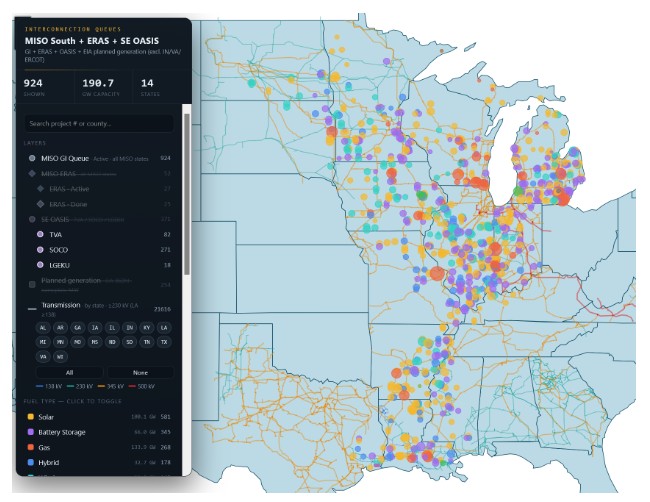
SREA Map of generation utilizing most current MISO queue data. Transmission layer source from OpenInfrastructure.org.
- MISO has already made its main interconnection queue more stringent in recent years by adding stricter readiness requirements, a megawatt cap, and financial penalties for developers who drop out. This requires greater risk on behalf of generation developers in the queue, and ensures that projects are much more likely to come to fruition.
- Plugging large loads into that interconnection process in a thoughtful manner, would likely increase the certainty of generation projects in the queue by simultaneously providing more accurate study results, and providing large load customers a marketplace of options to match their demand.
- Running parallel processes instead of one unified one creates exactly the kind of planning silos that make it harder to see the full picture of what's actually going to be built, where it’s going to be built, and how it all impacts the grid. MISO creating another parallel process (based on their ERAS experience) creates mismatches in model assumptions, study procedures, etc which causes many issues for projects that have already been in the main interconnection queue for up to 5+ years and are still not done yet. These projects cannot transfer to any new process without significant financial penalties.
MISO is already running a queue process with good candidates for future generation supply. Why not use it, and tailor a study approach around it, rather than building a new one that would be siloed from it?
The Fine Print
Beyond the big-picture process question, many stakeholders flagged several specific details in MISO's draft provided on July 16 that we think need real attention:
A permanent decision should require thoughtful consideration
If fully used, this new process could end up handling over 30 GW of generation and 20+ GW of load by 2030, a massive commitment of staff time and resources for a process that hasn't been stress-tested. That's a lot to lock in permanently right out of the gate.
“Electrically proximate” is being defined too loosely
FERC's original directive suggested load and generation could be considered “close” if they're within one or two substations of each other. MISO's draft would allow pairings anywhere within an entire Local Resource Zone — a much larger area which in MISO can include between most of the entire state to multiple states. That's a meaningful difference, because it changes how localized (or not) the grid impacts of these pairings really are.
Who pays for transmission upgrades?
FERC's order specifically raised concerns about cost-shifting for infrastructure at the wholesale level . As currently written, MISO’s proposal states that transmission for the Large Load portion of the request will be classified as Baseline Reliability or Other Projects, which are assigned essentially to a Balancing Authority or utility territory. That can comprise a variety of different customers, including a large load, but it doesn’t declare that the large load shares the whole burden so that other customers aren't left holding the bag for transmission upgrades that weren’t built to serve them.
The Bottom Line
Large loads are being added at an unprecedented, rapid pace - and that is a very real challenge for the grid. But if the process is rushed, it risks locking in rules that don’t hold up under study conditions, or real-world conditions.
By contrast, while it’s a different approach to large load and generation additions, SPP spent months working with stakeholders to develop the HILLGA process, an approach that FERC reviewed, accepted, and highlighted as an example of the kind of innovation it supports.
We think MISO should take that same care, slow down and consider stakeholder input before moving ahead. And above all, consider an approach that yields long-term benefits rather than short-term outcomes.


