
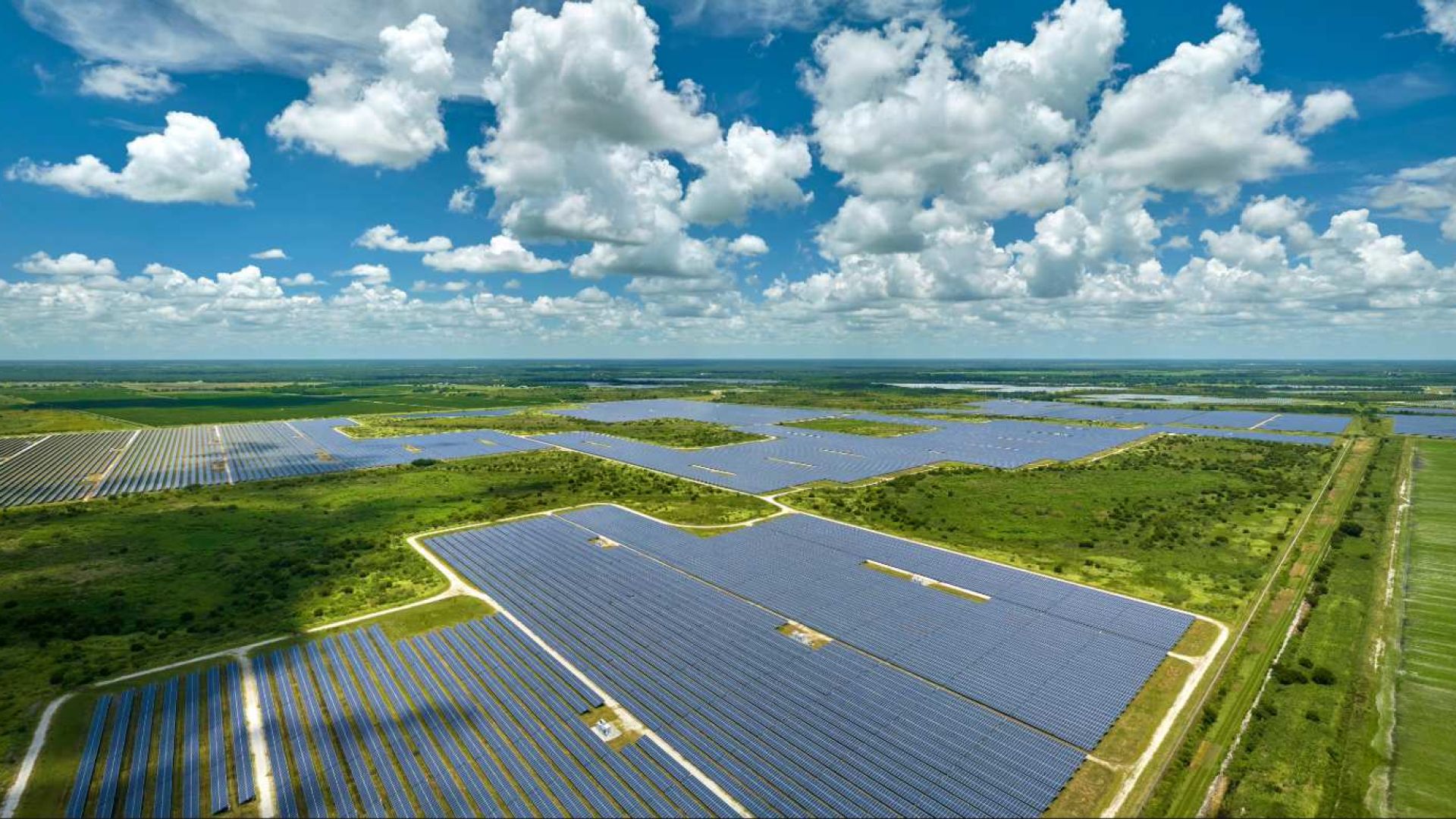
Landowners across the Southeast have long relied on income from leases - whether for timber, farming, hunting, or mineral rights - as a way to sustain generational land ownership. Utility-scale solar leases work the same way and offer a powerful way to generate income, preserve farmland, and invest in the future of rural communities across the Southeast. As solar energy production has ramped up, concerns over the displacement of agricultural land for non-food production purposes have also ramped up.
Land use studies from Arkansas, Georgia and Tennessee are helping piece together a more nuanced picture: solar’s economic promise for the Southeast is real, but the path we choose for land use and policy will decide how clearly that promise becomes reality in rural communities.
Georgia
Carl Vinson Institute of Government at the University of Georgia recently published the Utility-Scale Solar Land Use in Georgia Report, which concentrates on Georgia’s current utility-scale solar land usage and future projections. Georgia ranks seventh nationally in installed solar capacity across utility-scale, residential and community systems which is remarkable when you consider that current and planned utility-scale solar is estimated to:
- Occupy less than 0.2% of Georgia’s total land area;
- Occupy less than 0.15% of all farmland; and
- Occupy less than 0.3% of all forest land in the state.
Carl Vinson estimates that if current trends in solar energy generation continue, future total acreage in solar will reflect just 0.2% of forest and farmland combined. “Compared to the 4.6 million acres of forest and farmland lost to all forms of development in the past 50 years, the potential maximum 65,808 acres of land in solar represents just over 1% of that total conversion,” the report’s Conclusion states.
"Utility-scale solar offers Southeast communities long-term lease income, tax revenue for public services, and rural job creation,” Southern Renewable Energy Association Georgia Director Taylor Schindler said. “Local leaders are having to balance a growing industry with residents' and landowners' rights. While energy isn't the only land-use driver, America's Energy Renaissance has made this issue highly visible to taxpayers who want responsible, thoughtful growth. Communities face tough questions about pacing innovation while protecting quality of life."
Schindler said that in Georgia, he sees stakeholders seeking guidance and best practices to ensure the economic benefits of this development are realized without imposing undue burdens - something he hopes this Georgia study will help.
Arkansas
According to an analysis released in Spring 2025 by the University of Arkansas System Division of Agriculture, large scale solar arrays occupy only about 0.2% of the 13.7 million acres of agricultural land in Arkansas, despite recent rapid growth in the solar sector.
Private landowners often lease land for solar development, sometimes over a 30-year contract, the study explained. Voluntary solar land leases range from $450 to $2,500 per acre, with a preference for cleared, leveled or southward sloping lands that are not wetlands.
According to the study, up to 133,500 acres of land would be required across the state to double the state's current electrical generating capacity with solar, offsetting demand for power from natural gas, coal, nuclear and hydropower during the day.
"Even under this extreme level of solar development, which is unlikely to happen, solar would use less than 1% of the 13.7 million acres of agricultural land," said Dr. Michael Popp, Professor Agricultural Economics and Agribusiness.
Lauren Waldrip, Executive Director of Arkansas Advanced Energy Association, says the latest report highlights Arkansas farmers’ reality: “Farmers are doing everything right, but the math isn’t working anymore.” She notes agriculture is Arkansas’s largest industry and family farms are the lifeblood, adding that energy and food are complementary, not competing. As we move into 2026, she argues renewable energy projects can help keep farms productive, safe, and reliable while boosting the state’s energy economy.
Tennessee
The University of Tennessee led the way in the Southeast when they released their study to evaluate the state’s current and projected land use for utility-scale solar and its possible impacts on farmland - back in 2023.
This groundbreaking study showed the total amount of land required to generate 1,474 MW - the state’s then-current operational and contracted utility scale generation amounts - it would require between 8,197 to 14,743 acres of land or 0.056% of the state’s total land mass or up to 0.137% of the state’s agricultural lands.
Even the addition of 10 gigawatts of solar power by the TVA by 2035 would raise those percentages to just between 0.21% and 0.38% of the state’s total land or 0.52% to 0.93% of Tennessee’s farmland - and that’s assuming the 10GW isn’t spread out across TVA’s seven state footprint.
Researchers also examined the extent that Tennessee farmland has been lost to urban and residential uses. The report noted that the American Farmland Trust (AFT) ranked Tennessee third among all US states in terms of “nationally significant agricultural land projected to be converted to urban and highly developed and low-density residential uses by 2040. The study points to the state’s increasing population as one factor, a growing population that needs more electricity
“From 1997 to 2017, Tennessee’s land in farms decreased from 11.99 million acres to 10.87 million acres, a reduction of 1.11 million acres or about 9% of Tennessee’s farmland. The state’s farmland loss is primarily due to its increasing population, and these losses are projected to continue. The American Farmland Trust projects Tennessee will convert another 420,000 farmland acres to urban and residential uses between 2016 and 2040.”
So What Does This Mean?
Utility-scale solar is an opportunity for Southeast communities. It provides long-term lease income to local families, generates tax revenue for public services, and supports job creation in rural areas.
But none of this is possible without clear, fair rules that empower landowners—not restrict them.
Adopting smart ordinances that encourage investment while protecting their citizens is the way county and parish officials can uphold one of the region’s most cherished values—the right of every landowner to decide how best to use their land.


