

Southern Company has kicked off the stakeholder process for its 2026 Annual Cluster Study, and the message to developers is clear: the reforms are bigger, earlier, stricter, and much more in line with the national shift driven by FERC Order No. 2023, which now governs generator interconnection across the country.
Order 2023, issued in July 2023, requires all transmission providers, including vertically integrated utilities in non-RTO regions like the Southeast, to modernize their interconnection procedures, transition to first-ready, first-served cluster studies, strengthen site control requirements, increase financial readiness, and tighten withdrawal penalties.
The goal: reduce queue backlogs, increase transparency, and prevent undue discrimination in the interconnection process
Southern Company’s 2026 process represents its next major implementation step. Developers should plan accordingly.
How Southern Company Is Implementing Order 2023 Through the 2026 Cluster
Earlier, More Rigid Timeline — Submit Early or Miss the Cluster
Southern Company is opening the 2026 Cluster Request Window a full two weeks earlier, from February 17 – April 3, 2026.
Then, in alignment with Order 2023’s emphasis on procedural discipline, Southern Company added a 15-day “Application Review Period” (April 4–20). During this time, where:
- No new applications may be submitted
- No deficiencies may be cured
- Only deficiency-free applications move forward
This is straight out of Order 2023’s “first-ready” framework, designed to eliminate speculative or incomplete requests that slow down the entire queue.
ERIS Remains Standard in the Southeast
Just as in the 2025 cycle, developers overwhelmingly selected ERIS. Southern Company emphasized again that ERIS is sufficient for interconnection in its non-RTO footprint.
Order 2023 does not alter the ERIS/NRIS distinction—but it does require that all interconnection service types be studied according to consistent, non-discriminatory standards.
Site Control Requirements: Much Stricter (Because FERC Now Requires It)
One of the most consequential parts of Order 2023 was the requirement that site control be demonstrated at the time of application, not later in the process. Southern Company’s 2026 study now reflects this federal requirement.
Developers must show:
- Solar: 6 acres/MW
- Wind: 30 acres/MW
- Storage: 40–60 MWh per acre
- Thermal: 40 acres
Regulatory limitations may allow a deposit alternative ($10,000/MW, capped at $2M), but documentation must be detailed and credible. Order 2023 explicitly requires this type of proof-of-readiness to eliminate “placeholder” queue positions that cause cascading restudies.
Withdrawal Penalties and “Readiness” Framework
Order 2023 mandates higher financial commitments and stronger penalties for developers who withdraw from the queue after entering the cluster study. Southern Company’s 2026 process now includes:
- Escalating penalties through each study phase
- Penalties tied to network upgrade cost percentages (up to 20%)
- Use of penalties to offset upgrade cost increases for remaining projects
Again, this mirrors the “first-ready, first-served” structure adopted in Order 2023 to suppress speculative queue behavior.
Public Information Requirements (The SIGHT Tool)
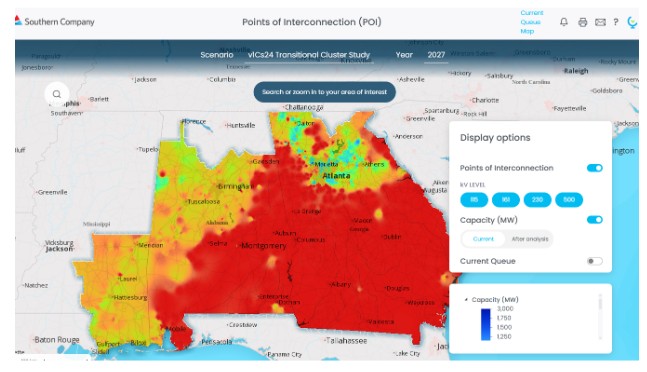
Order 2023 requires transmission providers to post publicly available interconnection information so developers can make informed siting decisions before filing. Southern Company’s SIGHT tool - loaded with hosting capacity indicators, DFAX values, and before/after loading analysis - is a direct response to this federal requirement. It will be updated within 30 days of each cluster study or restudy.
What It All Means for SREA Members
Order 2023 has reshaped generator interconnection nationwide, and Southern Company’s 2026 process is now one of the clearest examples of those reforms in action in the Southeast.
For developers, four themes matter most:
1. Be Early: Late applications will almost certainly fail during the rigid 15-day review period.
2. Be Complete: Order 2023’s readiness framework means your site control, modeling, and technical package must be fully aligned with federal standards on Day One.
3. Be Precise: Small inconsistencies in IBR modeling or acreage calculations will result in deferrals or disqualification.
4. Be Realistic: Withdrawal penalties are now very expensive. Enter the cluster only if you are prepared to proceed.
Southern Company is now firmly operating in an Order 2023 world, and so must Southeast developers. The 2026 cluster is not business-as-usual. It is a federally driven modernization of the interconnection process. SREA will continue monitoring implementation, gathering member feedback, and identifying opportunities to improve the process for renewable developers across the Southeast.


